External · LG AI Research
PCBWorld, small boards
Clean pass on 99 boards, under LG’s own rules and scoring.
KiCad 9.0.8 · 17 Nov 2026LG: best of fiveOurs: one run
Benchmarks
External · LG AI Research
Clean pass on 99 boards, under LG’s own rules and scoring.
External · LG AI Research
The 10 boards of LG’s medium test, 11 to 26 nets. Every LLM agent scores 0.
External · LG AI Research
PCBWorld’s small boards. Up and to the left is better. Each method’s time is on its own hardware.
PCBWorld takes open-source KiCad boards, strips their tracks, and asks a router to lay them again. KiCad’s own rule check scores the result. We rebuilt LG’s boards and LG’s scoring, and ran Lightcycle through them: one run a board, against LG’s best of five.
LG’s rows are Table 3 of the PCBWorld paper, the best of five rollouts a board, with Freerouting and the RL routers averaged over four seeds. Lightcycle’s are one deterministic run a board, with exact pad margins on, under each board’s own rules as LG prepared them. Those rules let a track pass inside another pad’s solder mask opening. soldermask keeps it out by default, and with that the small set is 0.99 (98 of 99).
dec3be7) with KiCad 9.0.8, the version LG used. They produced all 99 small boards and all 20 medium and large ones.eval/metrics.py). On the authors’ own copper it passes 99 of 99 small, 10 of 10 medium and 9 of 10 large boards.Across all 119 boards, Lightcycle’s copper drew no rule error. Every small and medium board passes.
soldermask also pours a ground plane on both layers by default. LG’s boards carry no pour and LG’s routers lay none, so the headline is without it. With it, the small set is 0.99 (98 of 99), and the medium and large sets do not move.
| Method | Kind | Small CP | Routability | Time, s | Medium CP | Routability | Time, s |
|---|---|---|---|---|---|---|---|
| Lightcycle | ours | 1.00 | 1.00 | 1.33 | 1.00 | 1.00 | 2.15 |
| PPO w/o finish | RL | 0.94 | 0.99 | 3.05 | 0.42 | 0.87 | 14.44 |
| PPO | RL | 0.86 | 0.95 | 1.83 | 0.45 | 0.85 | 10.77 |
| GRPO | RL | 0.85 | 0.98 | 3.54 | 0.10 | 0.69 | 11.20 |
| PPO (terminal) | RL | 0.82 | 0.95 | 2.58 | 0.38 | 0.81 | 12.60 |
| Freerouting | router | 0.80 | 0.91 | 7.09 | 0.78 | 1.00 | 9.94 |
| KiCadRoutingTools | router | 0.74 | 0.94 | 0.65 | 0.20 | 0.86 | 3.27 |
| GPT-5.4 | LLM agent | 0.65 | 0.91 | 231.15 | 0.00 | 0.62 | 865.83 |
| Qwen3.5-397B | LLM agent | 0.34 | 0.75 | 81.82 | 0.00 | 0.51 | 222.29 |
| GPT-5.4-nano | LLM agent | 0.30 | 0.73 | 100.76 | 0.00 | 0.59 | 510.25 |
| GPT-5.4-mini | LLM agent | 0.28 | 0.72 | 56.85 | 0.00 | 0.61 | 422.06 |
| OrthoRoute | router | 0.02 | 0.53 | 2.20 | 0.00 | 0.44 | 9.30 |
CP is clean pass. Lightcycle’s routability is KiCad’s count of connections made over those the bare board needs, which can differ slightly from LG’s pad-group count. Times are each method’s own hardware. Source: LG AI Research, PCBWorld: A Benchmark Environment for Engine-Grounded PCB Design Automation (KDD 2026 workshop), and its repository at 5773825. Our run: soldermask f555c96, Lightcycle 0.1.6, KiCad 9.0.8, 17 Nov 2026.
Public · soldermask-bench
186 public tasks, each a published board with its copper removed. Pass rate by board size.
Public · soldermask-bench
The 113 hidden tasks are scored on request, so no router can tune to them.
Held out · 249 boards
Boards none of our routers was developed on. The test plan was written before the first route.
Public boards · PCBench
PCBench boards with no rule errors before routing, stripped of copper and routed again. A different set and judge from PCBWorld.
Held out · 141 boards
Boards their authors routed on four layers, the test half frozen before the run.
Lightcycle’s rows are Lightcycle 0.1.5 on 16 Nov 2026, exact margins off as the product ships, judged by KiCad 10.0.8 because 10.0.6 can no longer be installed. With exact margins on: public 173, hidden 104, held out 219, four layers 98. The other routers’ rows are their September and October runs on KiCad 10.0.6.
Against a published placer
Cypress, from NVIDIA and Cornell (ISPD 2025), in its shipped setup. 60 held-out boards, six layouts each, the best kept.
Against people
705 open-hardware two-layer boards: how often a placement routes clean.
We lose here The layout gym
26 open-source KiCad boards, each laid out again under its own hole rules, net classes and custom rules. The development split: the boards our fixes were made against. The test split has not been run.
60 circuits, four tiers
The 60 circuits Claude wrote over MCP in September, rebuilt with no model in November. A pass: every part found, no ERC error, every net routed, KiCad clean.
We lose here The hard set
24 prompts: four layers, USB and Ethernet pairs, dense copper. 17 designed by our own design stage. The prompts stay private, so the set stays held out.
Every design we have kept
Every design this repository has kept, from September to November, built again with no model.
Head to head · siliXon’s own test
siliXon’s three published prompts, run on soldermask the way they ran them: Claude Code at medium effort, one tool connected. Three runs a prompt, the median shown. Hover a bar for its cost and errors. Below the charts, Haiku’s board from each prompt’s median run, as KiCad renders it.
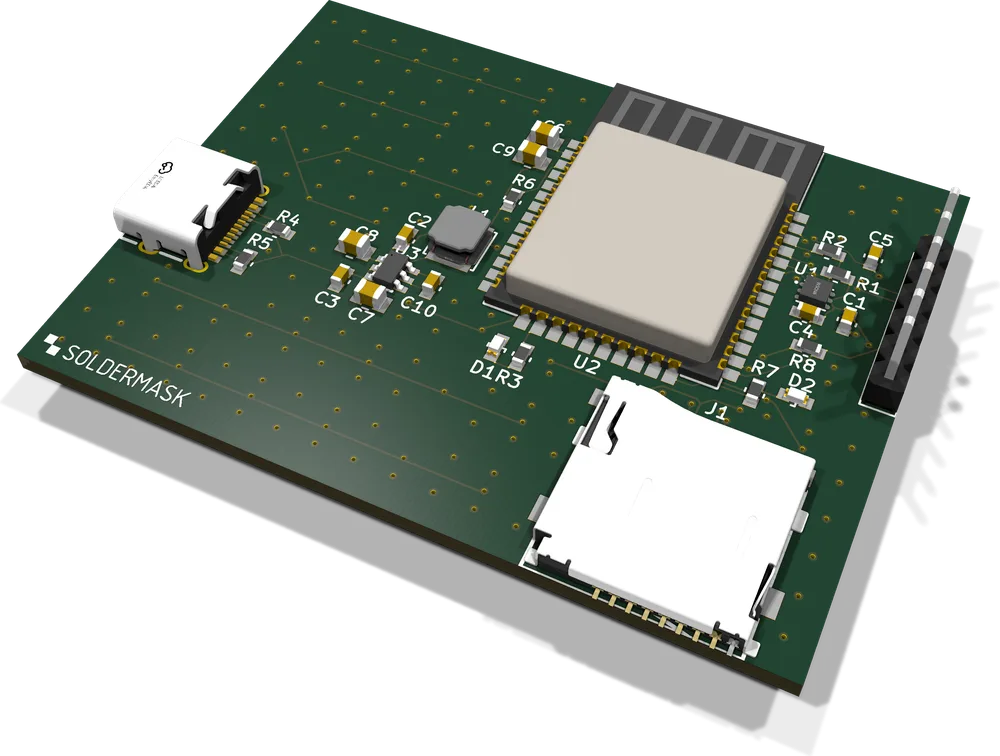
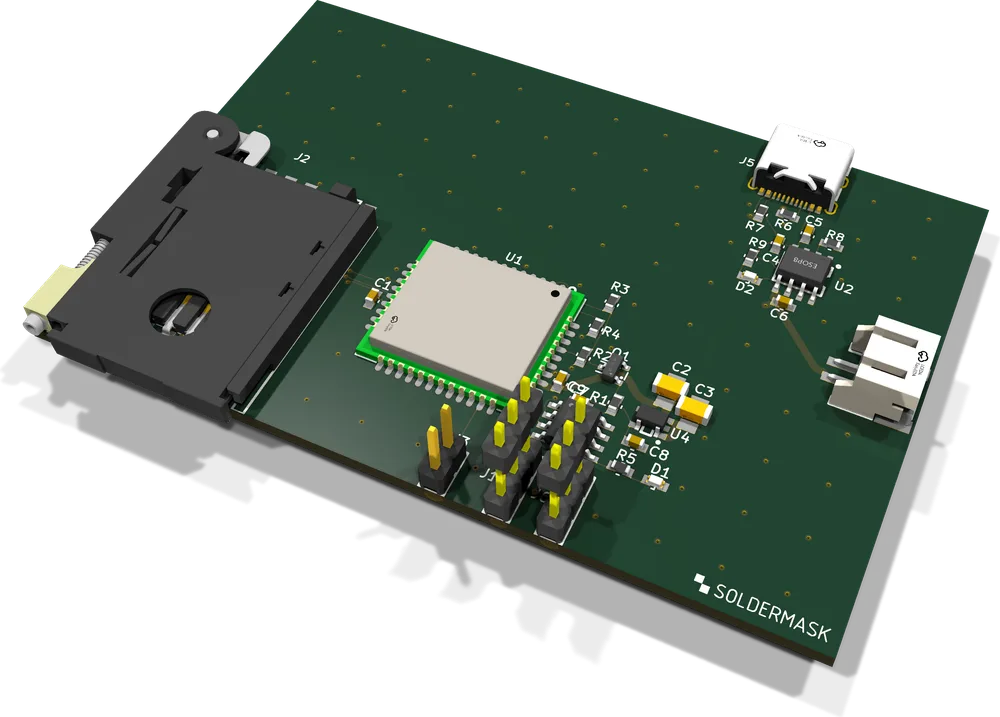
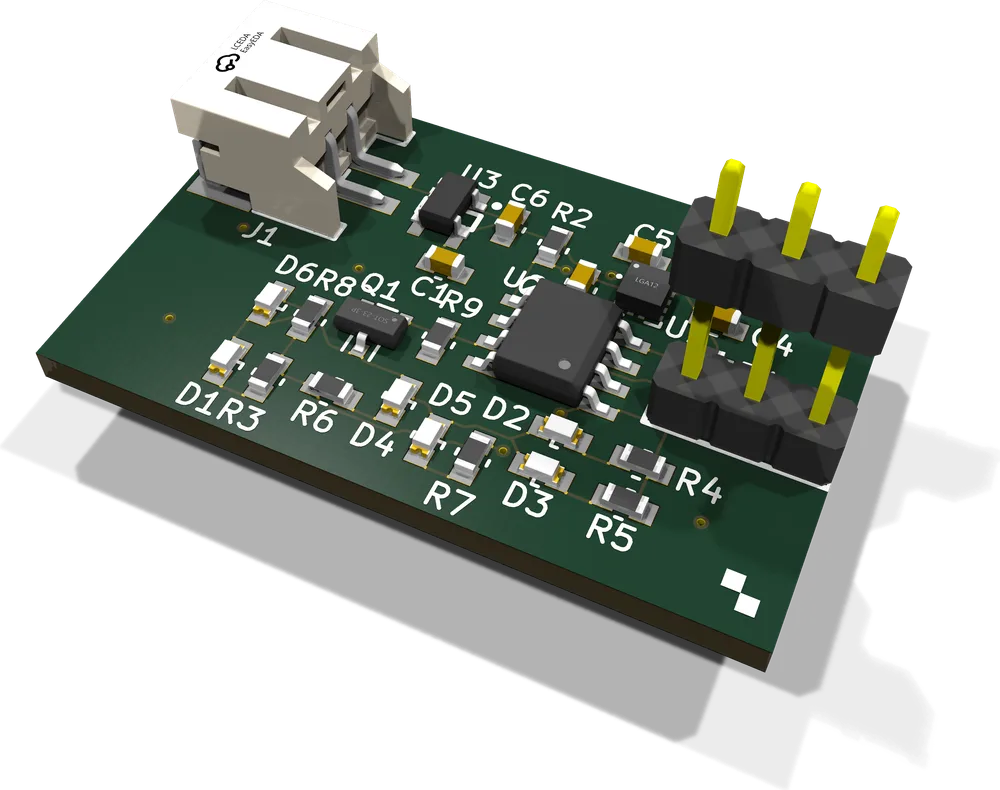
Haiku 5.5 with soldermask built all nine boards in 0.4 to 1.9 minutes, for 0.4 to 2.7 cents of Claude usage each. Seven came from Slipspace, which builds a board from circuit blocks that are each checked before they are used. All nine pass soldermask’s verdict with 0 KiCad errors under JLCPCB’s published limits. Since 18 Nov that verdict also fails a circuit that would not work as wired, such as an LED driven past its rating. Three of the nine boards from our first run, on 17 Nov, had one, so these are from a new run. Fable 5.2 with siliXon took 5.5 to 8.2 minutes and $1.25 to $1.64, not counting siliXon’s own compute or plan. soldermask runs on your own machine, so Claude usage is the whole bill. siliXon tested Fable only. The boards are not the same designs, and none has been made yet.
Simulation
144 September designs, one realistic fault at a time. The bars were set before the run. False alarms: 3 designs, 2.1%.
Contest · comma.ai’s PCBGolf
Score: the board’s bounding volume, plus 50 a via and 5,000 a copper layer. Lower is better. The last: five boards of one layer each, no vias.
Photonics · Mendicant
Nets routed by LiDAR, an open-source photonic router from another group. Apollo’s row is its published table.
soldermask-bench is public now. The other runners are in the soldermask repository, which opens with the release.
Their rules.Our numbers.